back to teaching
The elective module Digital Design and Fabrication explores the role of algorithms and logic in design. Students are taught Grasshopper, the algorithmic modeling plug-in for Rhinoceros 3D, as well as various digital fabrication processes, such as two axis cutters, five axis CNC, and additive manufacturing tools as such FDM and SLS. Through this course, they are exposed to various concepts within this realm, such as 3D scanning, parametric and generative design, mass customisation, and their relevance in design today. As an assignment, they decide on a direction within digital design to explore, eventually prototyping the research in 2D, 3D or 4D.
The elective module Digital Design and Fabrication explores the role of algorithms and logic in design. Students are taught Grasshopper, the algorithmic modeling plug-in for Rhinoceros 3D, as well as various digital fabrication processes, such as two axis cutters, five axis CNC, and additive manufacturing tools as such FDM and SLS. Through this course, they are exposed to various concepts within this realm, such as 3D scanning, parametric and generative design, mass customisation, and their relevance in design today. As an assignment, they decide on a direction within digital design to explore, eventually prototyping the research in 2D, 3D or 4D.
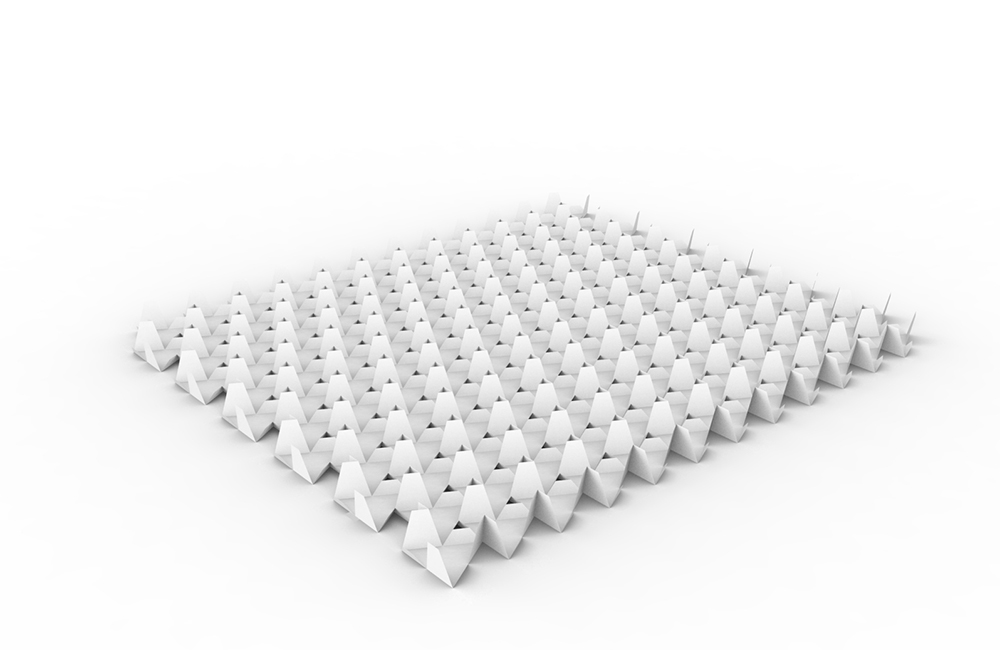
Contrasting Textures of a Surface,
by Mabel Low.
Mabel conducted her investigating on origami and tesselations. After her initial explorations, she was directed to explore how a single flat module could be folded and arranged to give a surface with contrasting textures on its two faces.
by Mabel Low.
Mabel conducted her investigating on origami and tesselations. After her initial explorations, she was directed to explore how a single flat module could be folded and arranged to give a surface with contrasting textures on its two faces.

Deconstructing Faces
by Eason Chow.
Eason was directed to investigate the properties of a digital mesh, using 3D scanned data of his face as a context of exploration. Various methods of deconstructing the mesh, yielded different “masks”, which were eventually 3D printed.
by Eason Chow.
Eason was directed to investigate the properties of a digital mesh, using 3D scanned data of his face as a context of exploration. Various methods of deconstructing the mesh, yielded different “masks”, which were eventually 3D printed.

